


How to Improve Forklift Visibility at Work

A forklift can be mechanically sound, properly maintained, and operated by a trained employee, yet still create a serious hazard when the operator cannot see a pedestrian, rack upright, dock edge, or obstruction in time. To improve forklift visibility, facilities need more than brighter warehouse lighting. They need controls that account for blind spots, changing loads, mixed pedestrian traffic, and the fast pace of daily material movement.
Visibility is a shared condition. The operator must be able to see the travel path, pedestrians must be able to recognize approaching equipment, and everyone in the area must understand where forklift traffic is expected. When one part of that system fails, collisions, product damage, and near misses become more likely.
Start With a Visibility Hazard Review
Walk the facility during active shifts rather than reviewing traffic routes only from a floor plan. Observe where operators slow down, sound horns, reverse repeatedly, or stop because they cannot confirm that a path is clear. Those are often the points where visibility controls will deliver the greatest return.
Pay close attention to aisle intersections, rack ends, doorways, trailer approaches, dock edges, battery charging areas, and transitions between indoor and outdoor work. Lighting conditions can change dramatically near open doors, in trailers, and around exterior staging areas. A route that is clear at noon may be difficult to navigate during an early-morning shift or after sunset.
Also review the difference between an empty forklift and a loaded forklift. A tall, wide, or irregular load can block the operator's forward view. Traveling in reverse may be necessary when conditions permit, but reverse travel introduces a different visibility problem: the operator must turn, look behind the truck, and account for pedestrians entering the travel lane.
Document repeated near misses and minor strikes, not just recordable incidents. A scraped rack post, damaged guardrail, or crushed pallet may be an early warning that traffic controls are not adequate.
Control Forklift Blind Spots Before They Become Incidents
Forklift blind spots are not limited to the area directly in front of a raised or oversized load. Counterweights, mast structures, load backrests, racking, parked trailers, doors, and corners can all hide people or equipment from view. The right solution depends on the hazard location and the type of traffic using that space.
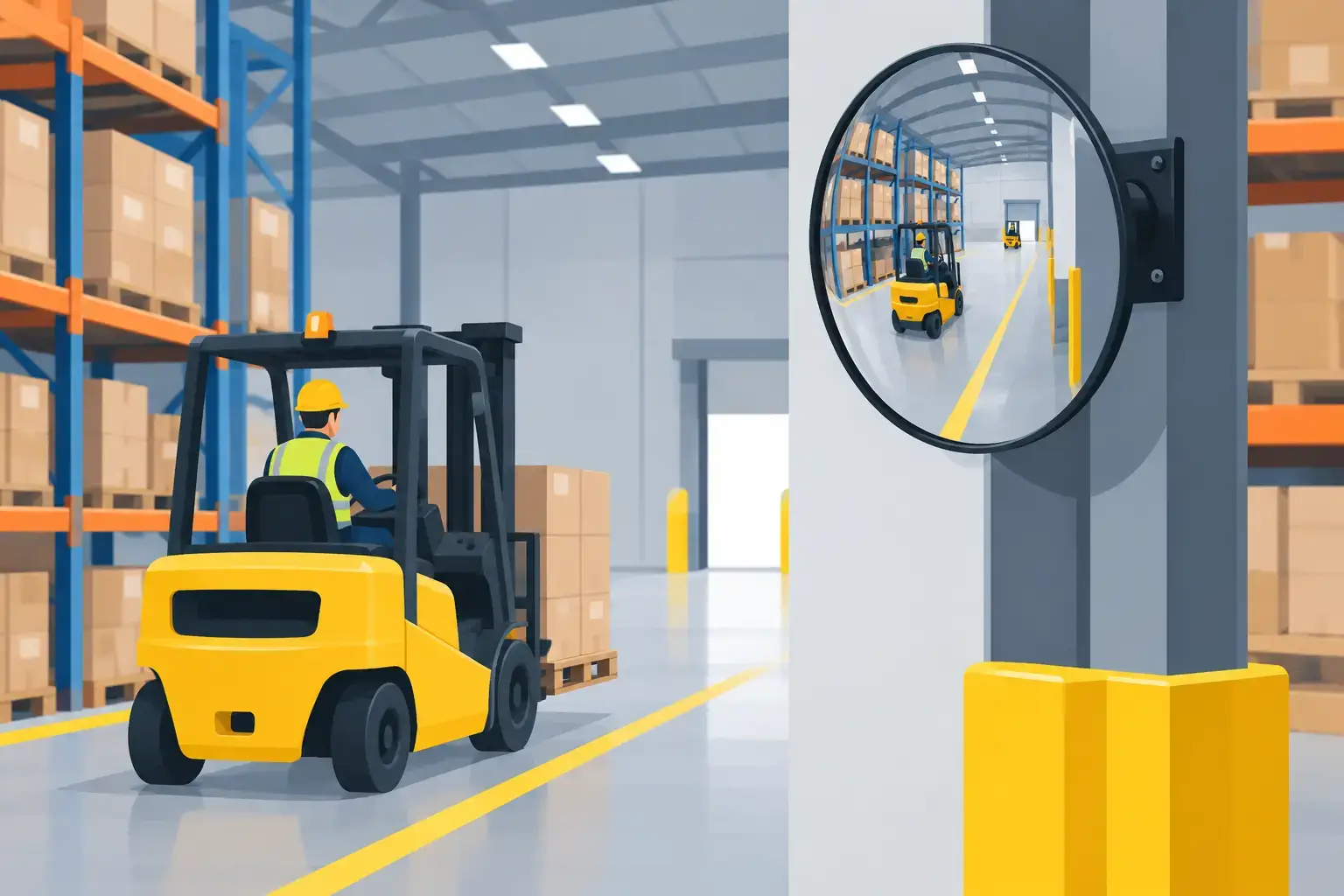
Convex safety mirrors are a practical control for fixed blind corners, aisle intersections, and pedestrian crosswalks. They help operators and pedestrians see approaching movement before either enters the conflict point. Mirrors need correct placement and regular cleaning. A dirty, damaged, or poorly aimed mirror can create false confidence instead of useful awareness.
Forklift-mounted lighting provides another layer of warning. Blue spot lights, red zone lights, and directional warning lights can alert pedestrians that a forklift is approaching or establish a visible exclusion area around the truck. These tools are especially useful in noisy environments where a horn may not be heard, or where shelving and stacked product block a direct line of sight.
Warning lights are not a substitute for maintaining safe distance or following site traffic rules. Their value comes from making forklift movement easier to notice before a pedestrian reaches the danger zone. Select the light pattern and mounting location based on aisle width, ambient lighting, floor color, and the types of forklifts in service.
Match Controls to the Travel Environment
A narrow-aisle warehouse may benefit most from corner mirrors, marked pedestrian crossings, and clear separation between pedestrian and forklift routes. A manufacturing floor with frequent cross-traffic may need highly visible warning lights and designated walkways. A busy dock area may require a combination of dock lighting, barriers, wheel chocks, signage, and communication procedures between forklift operators and drivers.
One control rarely solves every problem. Facilities with high traffic volume should build layers of protection so a missed horn, blocked sightline, or moment of inattention does not immediately become a collision.
Make Pedestrian Movement Predictable
Pedestrians often create the most difficult visibility variable because their movement is less predictable than a forklift's route. Employees may step from behind racks, leave workstations, cross an aisle to retrieve material, or walk through a loading area to reach a break room. Visitors and contractors may not understand the facility's traffic patterns at all.
Separate pedestrian routes from forklift lanes wherever the layout allows. Use floor markings, guardrails, gates, and crossing points to make the safe path obvious. A painted line alone may not provide enough protection in an area where pedestrians routinely handle materials, push carts, or work close to vehicle traffic.
At designated crossings, give both groups a clear expectation. Pedestrians should stop, look, and confirm that the operator has seen them before entering a forklift lane. Operators should reduce speed, scan the crossing, and be prepared to stop. The goal is not to place all responsibility on one group. It is to create a repeatable process that remains effective across shifts.
Training should reinforce that eye contact is helpful but not always possible. Window glare, face shields, mirrors, mast components, and load position can prevent a reliable visual confirmation. Employees should never assume they have been seen simply because they are in front of a forklift.
Improve Lighting Where Work Actually Happens
General facility lighting can appear adequate while still leaving critical areas in shadow. Check illumination at ground level in aisles, inside trailers, at dock doors, beneath mezzanines, and near staging lanes. Burned-out fixtures, dirty lenses, and inconsistent lighting between zones can make hazards difficult to identify.
Trailer interiors deserve special attention. Operators may move from a bright dock into a dark trailer, where depth perception and obstacle recognition are reduced. Portable dock lights, trailer lighting, and clearly defined dock procedures can improve the operator's ability to see load condition, trailer walls, and people working nearby.
Glare also matters. Bright exterior sunlight through an open dock door can temporarily limit an operator's view when moving between interior and exterior areas. Evaluate those transitions at different times of day. In some cases, traffic direction, staging location, or supplemental lighting may need to change.
Keep Loads From Blocking the Operator's View
Load management is a visibility control as much as a stability concern. Before travel, operators should assess whether the load blocks the forward view, extends beyond the pallet, contains loose material, or creates an unusual shape that affects maneuvering. Procedures should define when reverse travel, a spotter, reduced speed, or an alternate route is required.
Spotters can be useful for oversized loads, tight clearances, congested staging areas, and unusual moves. They are not a casual extra pair of eyes. A spotter needs a defined position, agreed-upon signals, and authority to stop the move. The operator must keep the spotter in view at all times. If contact is lost, movement stops.
Avoid creating loads that force operators to guess around corners or through doorways. Stable, properly stacked pallets and consistent load profiles reduce the need for improvisation. This also helps protect inventory and prevents unexpected shifts that can distract an operator at the worst moment.
Maintain Visibility Equipment and Operator Practices
Visibility tools only work when they are functional and used consistently. Include mirrors, warning lights, work lights, horns, backup alarms, cameras, and clean operator windows in regular inspection routines. Damaged light housings, obscured lenses, cracked mirrors, and dirty camera views should be corrected promptly.
Pre-shift inspections should also address the operator's direct field of view. Remove loose materials from the cab area, keep windows and mirrors clean, and report any mast, guard, or attachment issue that limits safe sightlines. For enclosed forklifts, defrosters, wipers, and interior lighting may be necessary to maintain visibility in cold, wet, or dusty conditions.
Training is the final control that connects equipment to daily behavior. Operators need practical instruction on blind spots, load-related view restrictions, intersection approach, pedestrian awareness, and the proper use of warning devices. Pedestrians need training that is equally specific to their role. Offering training in the languages used by the workforce helps make these expectations clear across the entire operation.
Forklift Safety Innovations helps facilities address these risk points with focused forklift pedestrian safety lights, mirrors, dock safety accessories, facility protection products, and training resources. The best starting point is the area where people and forklifts repeatedly compete for the same space. Correct that exposure first, verify that the control works during real operations, and continue improving from there.


Comments