


Best Warehouse Safety Mirrors for Forklift Traffic

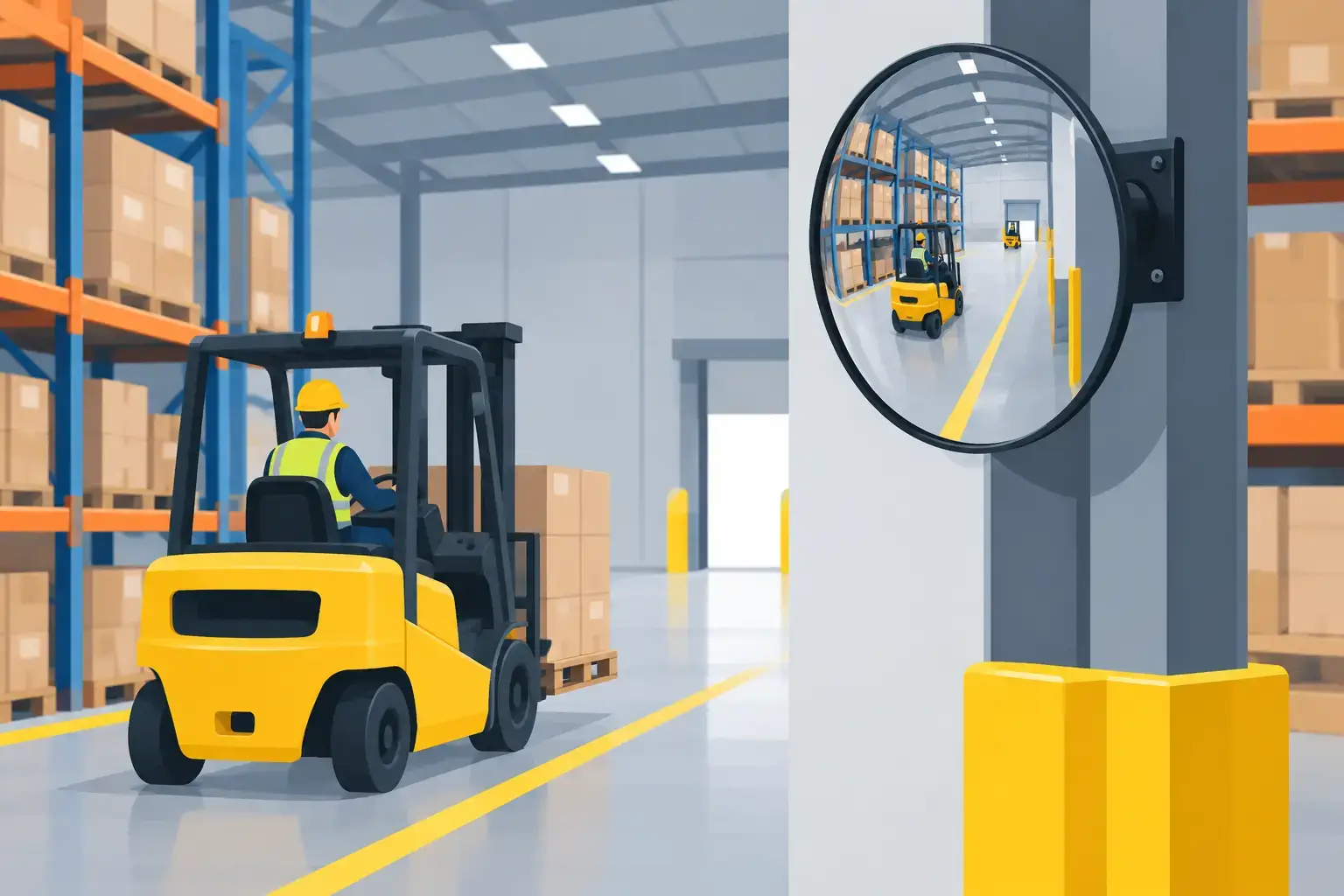
A forklift can clear a rack end, doorway, or cross aisle in seconds. At that same moment, a pedestrian, pallet jack, tugger, or second forklift may be approaching from the opposite direction with no direct line of sight. The best warehouse safety mirrors give operators and pedestrians earlier visual warning at these conflict points, helping facilities prevent the strikes, product loss, and downtime that follow blind-corner incidents.
A mirror is not a replacement for trained operators, marked pedestrian routes, speed control, horn use, or forklift warning lights. It is a practical visibility control that supports those measures where walls, racks, machinery, and building layout create unavoidable blind spots.
What Makes the Best Warehouse Safety Mirrors
The right mirror is the one that gives a useful view before a person or vehicle enters the hazard zone. Bigger is not automatically better. An oversized mirror at a narrow aisle may distort the view or become vulnerable to contact, while an undersized mirror at a busy intersection may not provide enough recognition distance.
Start with the traffic pattern. Ask who approaches the area, from which directions, at what speed, and whether pedestrians share the route. A forklift-only cross aisle needs a different solution than an exit door leading into a travel lane. Also consider the operator's viewing height. A mirror mounted for a standing pedestrian may not give a seated forklift operator the needed sightline.
The most effective installations provide a clear image, are positioned outside the normal impact path, and remain easy to inspect and clean. Mirrors should be part of a documented facility traffic plan, especially in high-volume shipping, receiving, and production areas.
Mirror shape should match the hazard
Convex mirrors are the standard choice for most indoor industrial applications because they widen the field of view. The curve allows users to see around obstructions, though objects appear smaller and farther away than they are. That trade-off makes proper placement and employee awareness essential.
A 90-degree convex mirror is generally suited to a single blind corner or a right-angle aisle intersection where users need to see one approaching direction. A 180-degree half-dome mirror gives a wider view across an aisle, doorway, or T-intersection. A 360-degree full-dome mirror is useful at four-way intersections, broad cross aisles, and areas where traffic can approach from multiple directions.
For exterior approaches, loading yard exits, or dock areas exposed to weather, use a mirror built for outdoor conditions. Outdoor-rated units need durable housings, mounting hardware that resists vibration, and a face material that performs in sunlight, rain, temperature changes, and wind.
Material affects durability and image quality
Acrylic convex mirrors are lightweight and commonly used indoors. They are a practical choice for many warehouse aisles, but they can scratch if cleaned with abrasive materials or exposed to repeated impacts. Polycarbonate mirrors offer greater impact resistance and are often preferred where accidental contact, vandalism, or debris exposure is more likely.
Glass can provide a crisp image, but it carries a higher breakage concern in active industrial environments. In most forklift applications, impact-resistant mirror materials offer a more appropriate balance of visibility and facility protection. The best choice depends on the location's exposure, not simply the initial purchase price.
Where Warehouse Safety Mirrors Deliver the Most Value
Mirrors perform best at known conflict points rather than being installed randomly throughout the building. Review incident reports, near-miss reports, forklift routes, pedestrian observations, and damaged rack locations. These often identify visibility hazards that have become routine enough for employees to overlook.
Blind rack ends and cross aisles
Rack ends are among the most common places for forklift visibility problems. Loads, uprights, stored product, and long aisle runs can block the operator's view until the truck is already entering the intersection. A correctly sized convex mirror mounted at the rack end or adjacent wall can reveal traffic before equipment crosses the aisle line.
Keep the mirror high enough to avoid routine contact from pallets, forks, and loads. It must still be low enough for operators to see while seated. After installation, test the sightline using the actual forklift models and load heights used in that area.
Pedestrian doors and break areas
A door opening directly into a forklift aisle creates a serious pedestrian exposure point. Employees leaving a restroom, office, maintenance room, or break area may step into traffic without seeing an approaching truck. A mirror can help both parties recognize movement earlier.
In these areas, pair the mirror with floor markings, door signage, pedestrian barriers, and forklift pedestrian safety lights where appropriate. If people routinely walk through the travel lane, the stronger long-term control may be a redesigned route or guarded crossing rather than relying on a mirror alone.
Dock doors and staging lanes
Loading docks have changing sightlines. Staged pallets, trailers, dock equipment, and temporary congestion can obscure views that were clear earlier in the shift. Mirrors can improve visibility at dock access corridors and staging-lane intersections, particularly where forklifts turn around fixed building features.
Avoid placing mirrors where trailer movement, dock doors, or material-handling equipment can strike them. For busy docks, inspect mounting hardware frequently because vibration can shift a mirror out of alignment.
Production cells and machinery entrances
Manufacturing facilities often have fixed equipment, guarding, conveyors, and work cells that limit visibility. A mirror at the exit of a production cell can give lift truck operators a view of pedestrian traffic and give employees a view of approaching equipment before they step into a shared aisle.
The key is to prevent the mirror from creating false confidence. If noise, distractions, or high pedestrian density are present, use it alongside physical separation and clear right-of-way rules.
How to Size and Position a Safety Mirror
Mirror diameter should be based on the distance from the user to the mirror and the width of the area that must be visible. As viewing distance increases, a larger mirror is usually needed to provide a recognizable image. A small mirror may show movement at a distance but not enough detail for a worker to identify whether the approaching object is a person, forklift, or cart.
Before drilling or mounting, conduct a live test. Hold the proposed mirror at the intended location and have a forklift and pedestrian approach from normal travel paths. Check the view from the operator seat, from pedestrian eye level, and from locations where workers naturally pause before entering the aisle.
Angle matters as much as size. The mirror should show the approach route, not overhead lighting, ceiling structure, or a narrow slice of floor. Adjust it after installation and revisit alignment when racks are reconfigured, machinery is moved, or traffic routes change.
Use mounting hardware appropriate for the surface. Wall-mounted mirrors work well at building corners and doorways. Post mounting may be necessary at open intersections, but posts should be protected from forklift impact with guards or placed outside travel paths. In high-risk locations, coordinate mirror placement with facility and product protection systems rather than creating another object that can be damaged.
Common Mistakes That Reduce Mirror Effectiveness
The most common mistake is treating a mirror as a stand-alone safety program. A mirror improves sightlines, but it does not control speed, stop an inattentive pedestrian, or compensate for an operator traveling with an obstructed view. Written traffic rules, operator training, pedestrian awareness, and equipment warning devices remain necessary.
Another problem is poor maintenance. Dust, forklift exhaust residue, condensation, and scratches reduce image clarity. Include mirrors in routine housekeeping and safety inspections. Clean them with materials approved for the mirror face, check brackets for looseness, and replace units with cracked, clouded, or severely distorted surfaces.
Facilities also make the mistake of installing mirrors without considering changing inventory. A mirror that works during one shift may be blocked by seasonal stock, temporary staging, or a new rack configuration. If the view is regularly obstructed, correct the layout problem or relocate the mirror.
Build Mirrors Into a Layered Forklift Safety Plan
The best warehouse safety mirrors support a layered approach to collision prevention. Use them with pedestrian walkways, aisle markings, barriers, speed management, warning signs, forklift lights, alarms, and operator training. Each control addresses a different part of the risk: visibility, separation, communication, or behavior.
Forklift Safety Innovations helps facilities identify practical controls for the places where equipment, people, and inventory compete for the same space. When evaluating mirrors, focus on the specific hazard rather than choosing a generic size or shape. A mirror that gives a clear, early view at one blind corner can prevent a costly event before it starts.
During your next floor walk, stop at the intersections where operators slow down, sound the horn, or lean forward to see around an obstruction. Those are the locations where a properly selected and positioned mirror deserves serious attention.


Comments