


When to Install Forklift Governors for Safer Travel

A forklift that travels too fast rarely stays productive for long. Excess speed reduces stopping margin, makes turns less stable, increases load-shift risk, and gives pedestrians less time to react. Facilities that install forklift governors can establish a more consistent travel-speed standard in areas where traffic, visibility, load conditions, or facility layout create elevated risk.
A governor is not a substitute for trained operators, clear traffic rules, or properly maintained equipment. It is a physical control that supports those measures by limiting how fast a truck can travel. For warehouse, manufacturing, and distribution leaders, that added consistency can reduce preventable equipment damage, pedestrian exposure, and costly disruption without changing the core material-handling workflow.
What Forklift Governors Control
A forklift governor limits vehicle speed by managing the truck's power or travel system. Depending on the forklift model and the governor design, the control may restrict maximum travel speed, reduce acceleration, or apply a programmed speed limit in a defined operating condition. The correct solution depends on the truck's make, model, power source, and electronic control architecture.
The objective is not to make every forklift operate at the same slow speed. A safe limit should reflect the work being performed. A truck moving pallets across an open yard may require a different setting than a truck operating in narrow warehouse aisles, around blind corners, near dock doors, or in a pedestrian-heavy production area.
Speed control also needs to account for the operating environment. Floor condition, grades, door thresholds, load height, load weight, attachment use, turning frequency, and congestion all affect the distance and time required to stop safely. A governor creates a ceiling, but operators still must travel at a speed that allows them to maintain control at all times.
When to Install Forklift Governors
Speed governors are most useful when a facility has identified a repeatable travel-speed problem that cannot be controlled reliably through signage and training alone. This may show up in incident reports, near-miss observations, damaged rack uprights, dock-door strikes, product loss, or recurring complaints from employees working near forklift routes.
Consider a governor when forklifts regularly share space with pedestrians, especially at crosswalks, aisle intersections, staging areas, battery rooms, production entrances, and break-room corridors. A reduced maximum speed gives both the operator and nearby employees more reaction time. It also reinforces the expectation that pedestrian zones require different driving behavior than open travel lanes.
Governors can also help in facilities with long, straight travel paths. These routes often invite speed creep because operators have clear visibility ahead and are trying to keep up with throughput demands. The risk changes quickly when a person steps out from an aisle, a pallet is staged in the lane, or another truck approaches from a cross route.
High-damage areas are another practical application. If the same doors, racks, guardrails, coolers, conveyors, or dock equipment are being struck, look beyond the individual incident. Layout, lighting, traffic flow, and operator practices may all contribute. Limiting travel speed can be part of a broader correction that includes facility protection, pedestrian warning devices, floor markings, and refreshed operator training.
Choose the Right Control for the Truck and Task
Before selecting a governor, identify the actual problem the facility needs to solve. A universal speed reduction may be appropriate for a compact indoor operation. In a mixed-use site, a single fixed limit may be too restrictive for outdoor transport while still being too fast for pedestrian intersections. The right approach depends on where the truck travels and how conditions change during the shift.
Start with the forklift manufacturer, model, year, serial information, power type, and current control configuration. Many modern electric and internal-combustion forklifts have programmable travel settings through OEM service tools. In those cases, a qualified technician may be able to adjust performance parameters without adding an aftermarket governor. Older units or trucks without suitable electronic programming may need a compatible external control solution.
Do not assume that any speed-control device will work across an entire fleet. Installation methods and electrical compatibility vary. An improper modification can create fault codes, reduce drivability, interfere with safety systems, affect warranty coverage, or leave the forklift unable to perform required work. Use a qualified forklift service provider and follow manufacturer guidance for the specific equipment.
The selected speed also matters. A limit that is too high may not address the hazard. A limit that is too low can encourage workarounds, slow critical operations, or lead operators to bypass the control if it is not protected and managed correctly. Safety managers and operations leaders should review travel routes, duty cycles, incident history, and operator input before establishing the setting.
Fixed Limits Versus Condition-Based Limits
A fixed governor sets one maximum speed for the truck. This can work well for forklifts assigned to a single indoor zone with predictable travel conditions. It is straightforward to communicate, monitor, and maintain.
Condition-based control may be better for larger facilities with different risk areas. Some systems can reduce speed based on a designated area, vehicle status, load condition, or other programmed input. These applications require more planning, but they can preserve reasonable travel efficiency in lower-risk areas while enforcing tighter control where people, equipment, and infrastructure are most exposed.
For example, a facility may need a lower speed near dock approaches and pedestrian doors but a higher allowable speed on a segregated transport lane. The safety objective is controlled movement, not arbitrary restriction.
Installation Should Be Part of a Safety Plan
A proper installation begins with a documented assessment of the truck and its operating environment. Maintenance personnel or an authorized service technician should confirm compatibility, inspect the forklift's existing condition, install the control according to approved instructions, and test operation before returning the truck to service.
After installation, verify that the forklift still accelerates, stops, steers, lifts, and travels as expected under normal operating conditions. Testing should include unloaded and typical loaded operation, forward and reverse travel, turns, ramps where applicable, and the routes where the truck normally works. Any unexpected fault, hesitation, reduced control response, or warning indicator should be addressed before the equipment is released.
Commissioning should confirm five practical items:
The maximum travel speed matches the approved setting.
The control does not interfere with braking, steering, lifting, or other safety functions.
Operators understand the new travel expectations and reporting process.
Supervisors know how to identify tampering or performance concerns.
Maintenance records document the modification, setting, testing, and service responsibility.
Operator communication is essential. A governor changes available vehicle performance, and operators need to know why the change was made. Explain the specific hazard being controlled, the zones or conditions affected, and the expectation that the programmed limit does not replace cautious driving. Clear communication helps prevent the misconception that a slower truck can be driven carelessly.
Pair Speed Control With Visible Hazard Controls
Forklift governors work best as one layer in a complete traffic-management program. A speed limit cannot solve a blind corner that has no warning device, a pedestrian crossing with poor visibility, or a congested staging area with no defined travel path.
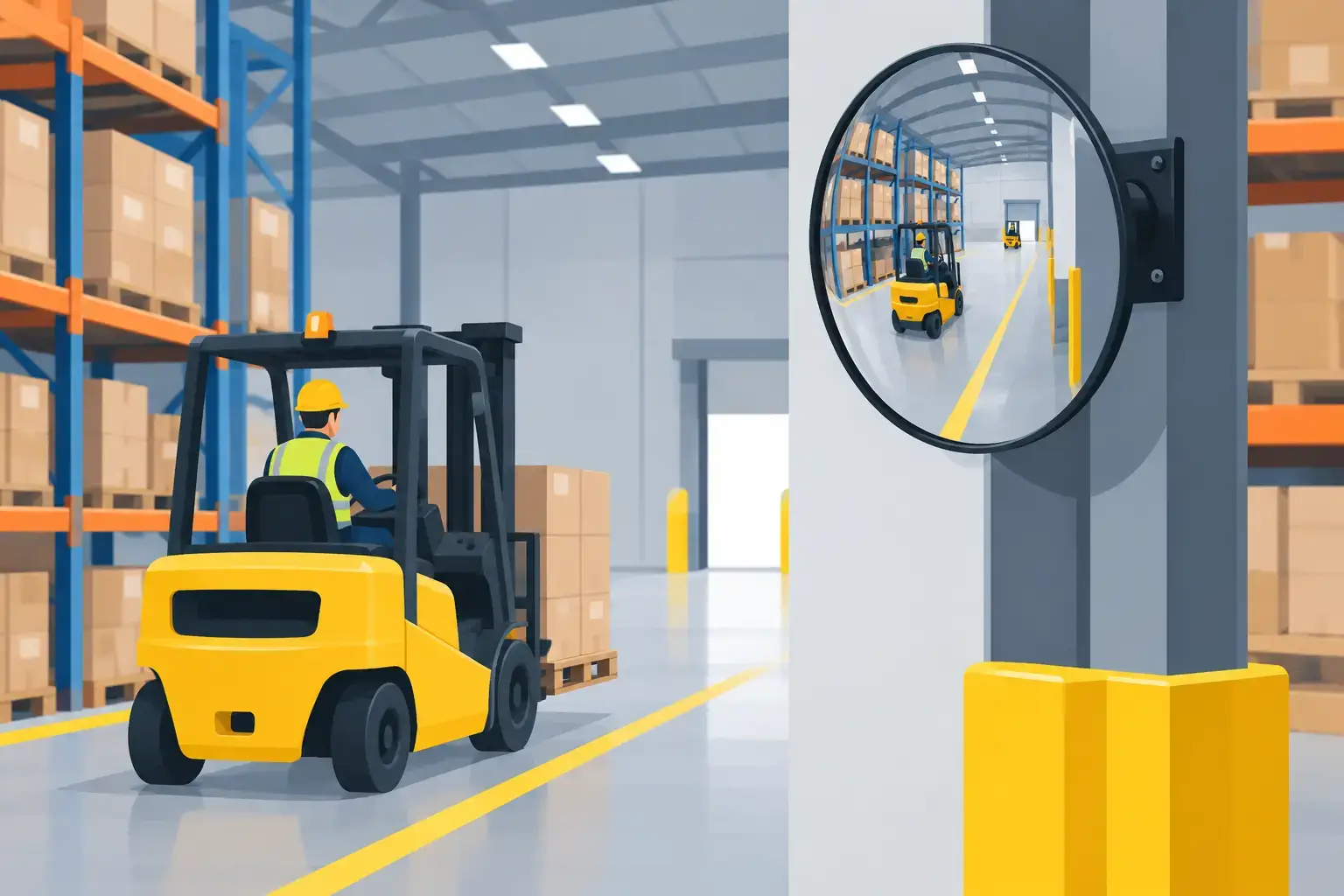
Review the routes where speed has been a concern. Forklift pedestrian safety lights can help warn employees of approaching equipment at intersections and aisle exits. Mirrors, visual warnings, floor markings, barriers, guardrails, and designated pedestrian walkways can further separate people from moving trucks. Dock safety accessories and facility protection products address other points where a speed-related impact can create serious damage or injury exposure.
Training should reinforce the operational rules behind the equipment. Operators still need to slow for wet floors, obstructed views, turns, ramps, raised loads, trailer entry, uneven surfaces, and pedestrian activity. Pedestrians need clear expectations for using marked walkways, making eye contact when appropriate, and avoiding forklift travel lanes. Forklift Safety Innovations supports this prevention-focused approach with safety equipment and training resources designed for active industrial environments.
Monitor Results After Installation
Do not treat installation as the end of the project. Track whether the governor is reducing the specific problem that justified it. Compare damage reports, near misses, speeding observations, downtime, and operator feedback over the following weeks and months.
If incidents continue, investigate the conditions rather than immediately lowering the speed limit again. The remaining cause may be poor aisle design, inadequate lighting, rushed scheduling, blocked sightlines, insufficient separation, or an unresolved training issue. Conversely, if the setting creates an operational bottleneck, evaluate whether the truck is being used in the right area or whether condition-based control would better fit the operation.
The most effective speed program is one operators can follow, supervisors can enforce, and maintenance teams can support. Set the limit around the real hazard, protect the equipment from unauthorized changes, and keep improving the traffic environment around it. A forklift governor is most valuable when it turns a known risk into a controlled part of everyday work.


Comments