


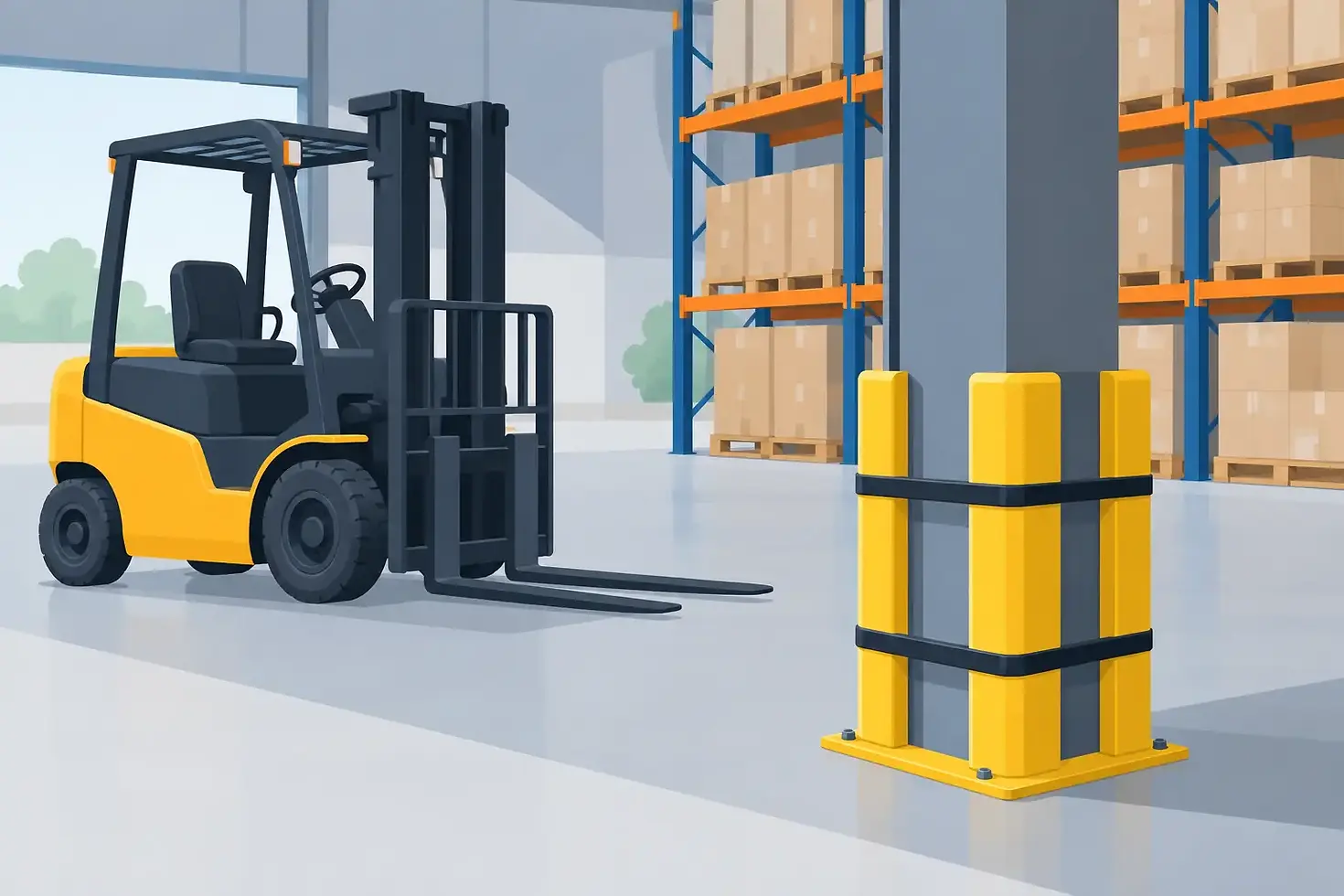
Warehouse Column Protectors for Forklifts

A single forklift strike can turn an unprotected building column into a recurring maintenance issue, a rack-alignment concern, or a costly operational interruption. Warehouse column protectors for forklifts create a physical buffer at one of the most exposed points in a facility: the support columns positioned near travel lanes, staging areas, dock approaches, and rack aisles.
For safety managers and operations leaders, the goal is not to assume every impact can be eliminated. The goal is to control the consequences when a tight turn, obstructed sightline, uneven load, or busy intersection puts a forklift too close to the structure. The right protection helps preserve the facility while reinforcing safer traffic patterns around known hazard points.
Why Columns Need Dedicated Protection
Building columns carry structural loads, but they are often placed exactly where forklift traffic creates exposure. A column at the end of a rack run, beside a pedestrian doorway, or near a loading dock can be struck repeatedly over time. Even low-speed contact may chip concrete, bend protective guards, damage paint, or create a hazard that maintenance must address.
More significant impacts can affect column bases, fasteners, nearby utilities, rack uprights, and stored product. The incident also takes time. A supervisor may need to inspect the area, isolate traffic, document damage, coordinate repairs, and determine whether a near miss requires corrective action.
Column protection is a facility-control measure, not a replacement for operator training, speed management, aisle design, or supervision. It works best as part of a layered approach that includes defined forklift routes, clear pedestrian separation, visibility controls, and regular operator training.
Where Warehouse Column Protectors for Forklifts Matter Most
Not every column faces the same risk. Walk the facility with forklift travel in mind rather than selecting protection by appearance alone. Look for tire marks, scraped paint, damaged concrete, repaired guards, pallet overhang, and points where operators regularly reverse or turn with limited clearance.
High-priority locations commonly include columns at dock doors, aisle intersections, rack ends, battery charging areas, production entrances, and lanes that connect receiving with storage. Columns beside shrink-wrap stations and outbound staging can also be exposed when traffic increases during peak shipping periods.
Consider the type of vehicle using each area. A sit-down counterbalance forklift, reach truck, order picker, pallet jack, and tugger do not follow identical travel paths. A protector that performs well against occasional pallet-jack contact may not provide adequate coverage where heavier forklifts make tight, frequent turns.
Match the Protector to the Impact Risk
Column protectors are available in several materials and configurations. The right choice depends on the column shape, available clearance, expected impact force, and whether the protection must be removable for inspections or building access.
Steel guards for high-contact areas
Steel column guards are commonly used where impact exposure is frequent or severe. They create a highly visible barrier around the column and can withstand repeated contact better than lighter-duty options. They are a practical choice around dock lanes, main forklift corridors, and busy rack intersections.
The trade-off is footprint. A steel guard takes up floor space and must be installed so it does not create a new obstruction, reduce required aisle clearance, or interfere with door swing, equipment access, drainage, or egress. Measure the operating envelope of the forklift, not just the width of the column.
Polymer and foam protection for lower-force contact
Polymer, molded plastic, and foam-style protectors can provide visible cushioning and help prevent cosmetic damage from lighter contact. Some fit around round or square columns without permanent anchoring, which can simplify installation in areas with lower impact exposure.
These products can be useful in pedestrian-adjacent spaces, office-to-warehouse transitions, and areas where visibility is the main concern. They are not interchangeable with a structural steel guard. If the site has a history of loaded forklift strikes, choose protection designed for that level of contact rather than relying on soft material alone.
Column wraps and base protection
For columns with repeated scuffing near the base, wraps and base guards can protect the most exposed portion of the structure. They may also improve visual awareness when supplied in bright safety colors. A wrap should fit securely and remain visible above accumulated debris, pallets, or stored materials.
Protection needs to cover the actual strike zone. Forklift fork tips, counterweights, carriage assemblies, pallet loads, and turning rear ends can contact different heights and sides of a column. Review the damage pattern before selecting guard height and configuration.
Measure Before You Buy
A quick measurement process prevents the most common purchasing mistake: ordering a protector that fits the column but not the operating area. Record the column’s width, depth, and shape, then measure the clearance between the column and nearby rack, walls, doors, equipment, and travel lanes.
Also document the traffic pattern. Note the direction of travel, turning radius, forklift type, load dimensions, and whether operators approach the location forward or in reverse. A guard may need protection on all sides, two exposed sides, or only the approach face. A fully enclosed design is not always necessary, but partial coverage should be based on observed traffic rather than assumption.
Floor condition matters as well. Concrete thickness, cracks, expansion joints, floor slope, and embedded utilities can affect anchor selection and installation. Maintenance teams should confirm the anchoring method and inspect the site before drilling. If a building engineer or facility owner sets requirements for structural-column access, involve them early.
Installation Should Support Safe Traffic Flow
A column protector should be positioned to absorb or deflect contact before the forklift reaches the column. It should not be installed so tightly that a direct hit transfers force into the structure, and it should not sit so far away that it unnecessarily narrows the aisle.
Use high-visibility color where it improves recognition, particularly at intersections and dimmer areas. Visibility products such as forklift pedestrian warning lights can complement column protection where people and powered industrial trucks share space. The guard protects the fixed structure; warning controls help reduce the chance that people or equipment reach the conflict point in the first place.
After installation, observe traffic during a normal shift. Operators may take turns differently than expected when trailers are present, staging changes, or a lane becomes congested. If the guard is being contacted routinely, treat that as information. The protection may be doing its job, but the traffic pattern, aisle width, speed expectation, or operator visibility may need attention.
Inspect Protectors After Every Meaningful Impact
Column protectors are often installed and forgotten until a major incident occurs. Make them part of routine facility inspections. Check for bent steel, loose anchors, cracked welds, torn polymer, missing hardware, shifted positioning, and damage to the concrete beneath or around the guard.
A damaged guard should not simply be repainted and left in service. If it has absorbed a substantial impact, inspect the column, the floor anchors, and nearby rack or utility connections. Record the event and identify what led to it. A repeated strike at the same location may point to an operational condition that equipment alone cannot solve.
This inspection discipline supports a stronger safety culture. Operators are more likely to report contact and near misses when leaders respond by improving conditions rather than treating every event as an individual failure.
Build Column Protection Into a Larger Facility Plan
The best results come from treating column guards as one part of facility and product protection. Pair them with rack protection where rack ends are exposed, dock safety accessories near trailer loading zones, clear floor markings, adequate lighting, and operator training that addresses site-specific hazards.
Forklift Safety Innovations supports this prevention-focused approach with specialized products for forklift environments, including facility protection, pedestrian safety, and training resources. For a multi-location operation, standardizing column-protection specifications can also simplify purchasing, maintenance, and inspection expectations across sites.
Start with the columns that already show evidence of contact. Those marks are not just maintenance concerns - they are a practical map of where your facility needs a stronger layer of protection.


Comments